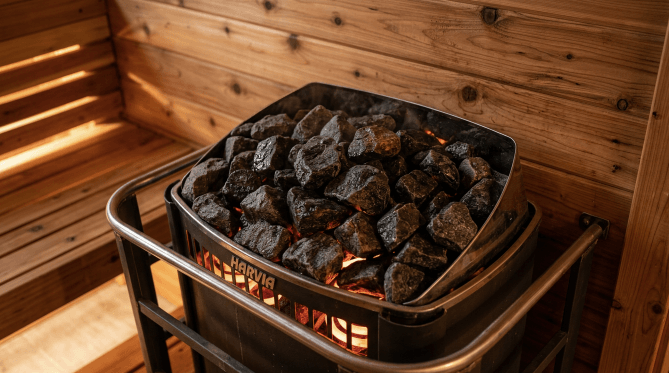
Choosing between electric and wood heat for a sauna heater comes down to three factors: installed cost, ongoing effort, and whether the site has 240-volt power available. Electric heaters cost less to install in a home with existing service, run $1 to $2 in electricity per session, and need almost no maintenance beyond an annual element check. Wood-fired heaters cost less to buy but more to install correctly, require a steady supply of seasoned fuel, and appeal most to buyers who already enjoy tending a fire.
Step One: Check What Power Is Actually Available at the Site
Before comparing heat types on preference, find out what the site can support. Most electric heaters above 6 kilowatts need a dedicated 240-volt circuit on a 30 to 40 amp double-pole breaker, and a detached cabin far from the main panel may need a sub-panel run that adds real cost to the project. A wood-fired heater sidesteps all of that, needing only a small fan-forced air intake and a properly clearanced chimney, which makes it the more practical starting point for a remote site with no nearby electrical service. Get a quote for the electrical run before falling in love with a specific electric model, since that number alone sometimes settles the decision.
Step Two: Compare the Real Installed Cost, Not Just the Heater Price
A mid-size 8 kilowatt electric heater typically costs $800 to $1,400 before installation, with the electrical work adding another $500 to $1,500 depending on distance from the panel. A comparable wood-fired heater often costs less upfront, around $700 to $1,200, but the chimney kit, roof flashing, and proper clearance framing can add $600 to $1,000 of its own, narrowing the gap between the two more than most buyers expect. Specialty dealers, including the SweatDecks sauna heaters collection, list both heater types with rated output and stone capacity side by side, which makes an apples-to-apples cost comparison easier before ordering either one.
Step Three: Weigh the Ongoing Effort Against How Often You’ll Actually Use It
Electric heat asks almost nothing of the user beyond flipping a switch and waiting. Wood heat asks for seasoned, kiln-dried fuel, split and stored dry through the season, plus ash removal after most sessions and a chimney inspection at least once a year. Someone who plans to use a cabin four or five times a week benefits more from electric’s near-zero effort, since the wood routine adds up fast at that frequency. Someone who sees the sauna as a weekend ritual, and who already enjoys the process of building and tending a fire, often finds the wood routine part of the appeal rather than a chore.
Step Four: Factor in Heat Quality and Session Feel
The two heat types do not feel identical even at the same air temperature. A wood-fired heater tends to produce a drier, more intense heat at the stones, and pouring water over rocks that have been heated by an open flame gives a sharper burst of steam that longtime sauna users often describe as more authentic. An electric heater’s digital control holds a steadier, more predictable temperature through a full session, which some users prefer precisely because it removes the guesswork. Neither produces a wrong result; the difference is closer to gas range versus induction cooktop than to good versus bad.
Step Five: Check Local Code and Insurance Before Committing to Wood
A wood-fired heater’s chimney pass-through needs clearance to combustible material specified by the manufacturer and enforced by local code, usually a minimum of 2 inches at the ceiling and more at the roof. Skipping this is not a minor oversight; it is a fire code violation and, in many cases, a reason a homeowner’s insurance policy could deny a claim. Electric heaters carry their own code requirements around circuit sizing and a visible disconnect switch, but they avoid the open-flame and chimney clearance questions entirely, which is one reason inspectors tend to sign off on electric installations faster.
See also: Indexed Universal Life: Merging Insurance with Investment Flexibility
What Does the Research Say About Regular Sauna Use, Regardless of Heat Source?
The cardiovascular research on sauna bathing does not separate outcomes by heat type, since the studies track how often someone uses a sauna rather than whether the heat comes from wood or electricity. A 2023 review in Mayo Clinic Proceedings examined how sauna bathing interacts with other lifestyle habits and found some added association with favorable outcomes when paired with regular exercise. An older but still widely cited paper in The American Journal of Medicine reviewed both benefits and risks of sauna bathing across a range of health conditions. A separate paper in the American Journal of Physiology examined the physiological effects of heat and cold exposure, with specific reference to Finnish sauna practice, describing the body’s adaptive response to repeated heat exposure. These findings apply to consistent use of either heat type, not to one method over the other.
Step Six: Think About Long-Term Maintenance in a Freeze-Thaw Climate
Electric heaters mounted outdoors in a freeze-thaw region benefit from a yearly check of the disconnect switch and any exposed conduit, since repeated freezing and thawing can work fasteners loose over several winters. Wood-fired heaters need their chimney cap and roof flashing inspected every fall, since ice damming around a poorly sealed roof penetration is one of the more expensive repairs a sauna owner can face, often costing more than the heater itself to fix correctly once water gets behind the flashing. Neither type demands constant attention, but a five-minute fall inspection routine, checked against a simple written list, catches small problems before a hard freeze turns them into a spring repair bill. Buyers who skip this step in year one often learn the lesson only after a chimney leak or a corroded electrical connection forces an off-season repair that routine maintenance would have caught for free.
Frequently Asked Questions
Is electric or wood heat cheaper to run? Electric is cheaper per session in most areas, typically $1 to $2 in electricity for a 45-minute run. Wood has a lower fuel cost if you split your own wood, but a delivered cord runs $250 to $400.
Does a wood-fired heater need a chimney? Yes, an insulated chimney pipe with manufacturer-specified clearances to combustibles, usually at least 2 inches at the ceiling pass-through and more at the roofline.
Which heat type is better for a first-time buyer? Electric, in most cases, since it is simpler to install correctly and does not require fuel storage or ash cleanup.
How long does each heat type take to warm a cabin? A correctly sized electric heater reaches 170 to 180 degrees in 30 to 45 minutes. A wood-fired heater in the same cabin often takes 45 to 60 minutes.
References
- Benefits and risks of sauna bathing, The American Journal of Medicine, 2001
- Does the Combination of Finnish Sauna Bathing and Other Lifestyle Factors Confer Additional Health Benefits? A Review of the Evidence, Mayo Clinic Proceedings, 2023
- Effects of heat and cold on health, with special reference to Finnish sauna bathing, American Journal of Physiology – Regulatory, Integrative and Comparative Physiology, 2018
By Grace Whitfield